Concert Season 2026
Easter Alleluia
15 April 2026, 7:30 p.m., Winter Refectory
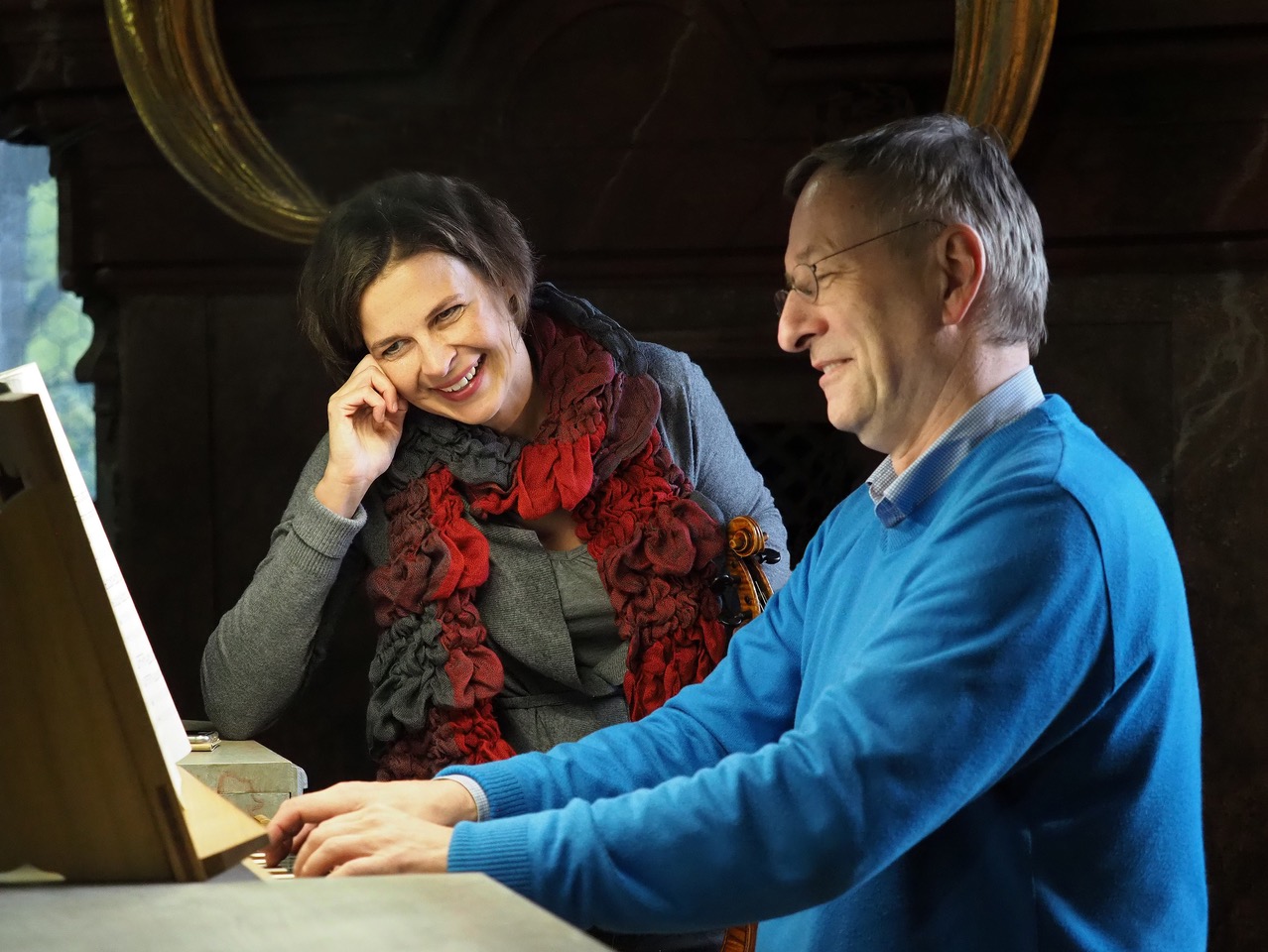
J. Tůma – organ positive, Sedláková-Hůlová – violin
The concert programme is focused on the theme of joy arising from Christ’s Resurrection. From the monastery’s archive, J. K. Kuchař’s Partita in C major (based on the Easter Alleluia) will be performed, as well as H. I. Biber’s Rosary Sonatas. From contemporary works, Prof. J. Tůma’s “Rosary of Light” will be presented.
Jaroslav Tůma
He is a concert organist and professor at the Academy of Performing Arts in Prague. He also performs on the harpsichord, clavichord, fortepiano, and other keyboard instruments.
He studied at the Academy of Performing Arts in Prague under Prof. Milan Šlechta (organ) and Prof. Zuzana Růžičková (harpsichord). He is the winner of first prizes in organ improvisation competitions in Nuremberg in 1980 and Haarlem (Netherlands) in 1986. He is a laureate of several interpretation competitions, including Linz 1978, the Prague Spring Competition 1979, and the Johann Sebastian Bach Competition in Leipzig in 1980, among many others.
Tůma’s repertoire includes major works by Czech and international composers across a wide range of styles from the Renaissance to the 21st century. His discography currently includes 64 solo titles released by Supraphon (until 2002) and predominantly by Arta Records (from 1991 to the present). These include recordings of works by Johann Sebastian Bach (the Goldberg Variations in two versions — harpsichord and two clavichords; The Well-Tempered Clavier on clavichord; Organ Mass; Leipzig Chorales; The Art of Fugue on organ), Antonín Rejcha (36 Fugues for piano on a historical fortepiano by Anton Walther), Václav Jan Tomášek (Eclogues), Vítězslav Novák (St. Wenceslas Triptych), Leoš Janáček, Paul Hindemith (Sonatas), and several CDs of organ improvisations, such as “My Country,” a set of improvisations on themes from Bedřich Smetana’s symphonic cycle. Some of his organ recordings have also been released in Germany and Poland, including on historical organs by Wilhelm Sauer and Schlag & Söhne. Most of his projects document the richness and beauty of Czech, Moravian, and Silesian organ-building traditions.
Jaroslav Tůma also devotes himself to chamber music. Two versions of Heinrich Ignaz Franz Biber’s Rosary Sonatas have been recorded on CD, one with Gabriela Demeterová (1996 and 1997) and another with Lucie Sedláková Hůlová (2020), with Tůma performing the organ continuo. He is also the composer of music for Pavel Koutecký’s documentary film “Transformations of Prague Castle,” two collections of organ works based on themes by Adam Václav Michna (Svaté lásky labirynth aneb Česká mariánská muzika 2014 and Loutna česká 2016–2023), a collection of organ compositions titled “I Would Gladly Go to Bethlehem,” and scholarly publications such as “On the Interpretation of Organ Music with Regard to Other Keyboard Instruments” (2016), “On Selected Organ Works of Petr Eben” (2019 — with recordings of Sunday Music, Laudes, etc.), and “The Clavichord — an Almost Forgotten Instrument” (2019 — with recordings of works from the 18th and 20th centuries on a historical instrument by Johann Christoph Georg Schiedmayer). He also engages in collective improvisation. For example, between 2015 and 2017 he initiated a series of music-and-dance performances titled “The Chosen One, or Gregory on the Rock,” in which selected texts from the novel by Thomas Mann served as inspiration for five musicians (Jaroslav Tůma, Stefan Baier, Jan Rokyta, Liselotte Rokyta, and Alan Vitouš), a reciter (Josef Somr or Jan Hartl), and dancer Adéla Srncová.
Lucie Sedláková Hůlová
Violinist Lucie Sedláková Hůlová is a graduate of the Prague Conservatory and the Academy of Performing Arts (HAMU). She has performed hundreds of successful concerts around the world. As a soloist, she collaborates with various partners and orchestras, is a sought-after chamber musician, and is also active in teaching.
Her musical role model was her father, violinist Pavel Hůla, with whom she often and gladly performed. After his death, she assumed the artistic leadership of the chamber orchestra Praga Camerata, of which she has been a member and soloist since its founding in 2001. At the same time, she is the leader of the Praga Camerata Quintet. Together with her husband, cellist Martin Sedlák, she forms the Czech String Duo, and with their two children, Magdalena and Lukáš, they perform as Sedlák Virtuosi.
In 1998, Lucie and Martin founded a piano trio, which since 2004 has been known as the Kinsky Trio Prague, where she now performs with pianist Veronika Böhmová. For several seasons, Lucie was active in youth orchestras (the European Union Youth Orchestra and the UBS Verbier Festival Orchestra), where she collaborated with some of the world’s most renowned conductors and soloists and gained valuable experience. Since 2012 she has been a lecturer and since 2019 also the artistic director of the international chamber music courses “PELLEGRINA with the Kinsky Trio and Friends.” She is regularly invited to the Martinů Quartet chamber music courses “PLAYWIP.”
She is also engaged in historically informed performance of early music. In this field, she collaborates with renowned ensembles (such as Musica Florea, Capella Regia, Collegium 1704, Capella Ornamentata, among others) and soloists. In 2020, together with organist Jaroslav Tůma, she recorded the complete cycle of Biber’s Rosary Sonatas in original scordatura tunings on period instruments (2CD, ARTA label). This album was described by the magazine Harmonie as “the best Czech violin project of 2020” in terms of its dramaturgical contribution.
Lucie performs on a rare violin made by Mathias Albanus in 1696, once owned by the master Jaroslav Kocian, and on a copy of a Baroque violin by Giuseppe Guarneri, crafted by Dalibor Bzirský.